SaaS Affiliate Marketing From the Practitioner Side: The Search-Led Funnel Behind $121K in GoHighLevel Commissions
A working affiliate breaks down the search-led YouTube funnel, affiliate-only offer and recurring commissions behind $121K in GoHighLevel payouts, plus a checklist.
 Tin Rovic8 min read
Most advice about SaaS affiliate marketing is written by people who run affiliate programs. This piece is written from the other side of the dashboard.
I’m a YouTube creator and agency owner from Croatia. I build AI receptionists, websites and automations for local businesses like dental clinics, restaurants and beauty salons, and I teach other agency owners how to do the same. The software I used to build most of that work was GoHighLevel, so I started recommending it with an affiliate link.
Years later, my GoHighLevel affiliate dashboard shows more than $121,000 paid out in recurring commissions. No paid ads, no viral video, and no huge audience when I started.
This article isn’t a recap of how that happened. It’s a breakdown of the funnel itself, stage by stage, so you can see exactly where affiliate revenue is created and where it leaks. If you’re an affiliate, you can copy it. If you run a SaaS affiliate program, you can see which parts you control. Either way, there’s a practitioner checklist at the end.
The Numbers First: What a Compounding Affiliate Funnel Looks Like
Here’s where things stood when I took this screenshot: $121,320.79 in total paid commissions, another $2,858.79 unpaid and pending, and zero overdue. These are affiliate payouts, not YouTube ad revenue.

The important detail is the shape of that number, not the size. It didn’t come from one launch. It came from customers who signed up, stayed and kept paying month after month, which is what a 40% recurring commission rewards. I broke down the full GoHighLevel revenue case study, including the content and bonus strategy behind these numbers on my own blog if you want the long version.
What follows is the funnel that produced it.
The Search-Led SaaS Affiliate Funnel, Stage by Stage
Every affiliate funnel has the same job: move a stranger from a problem to a paying, retained customer. Mine has six stages, and each one fixes a specific leak that kills most affiliate programs.
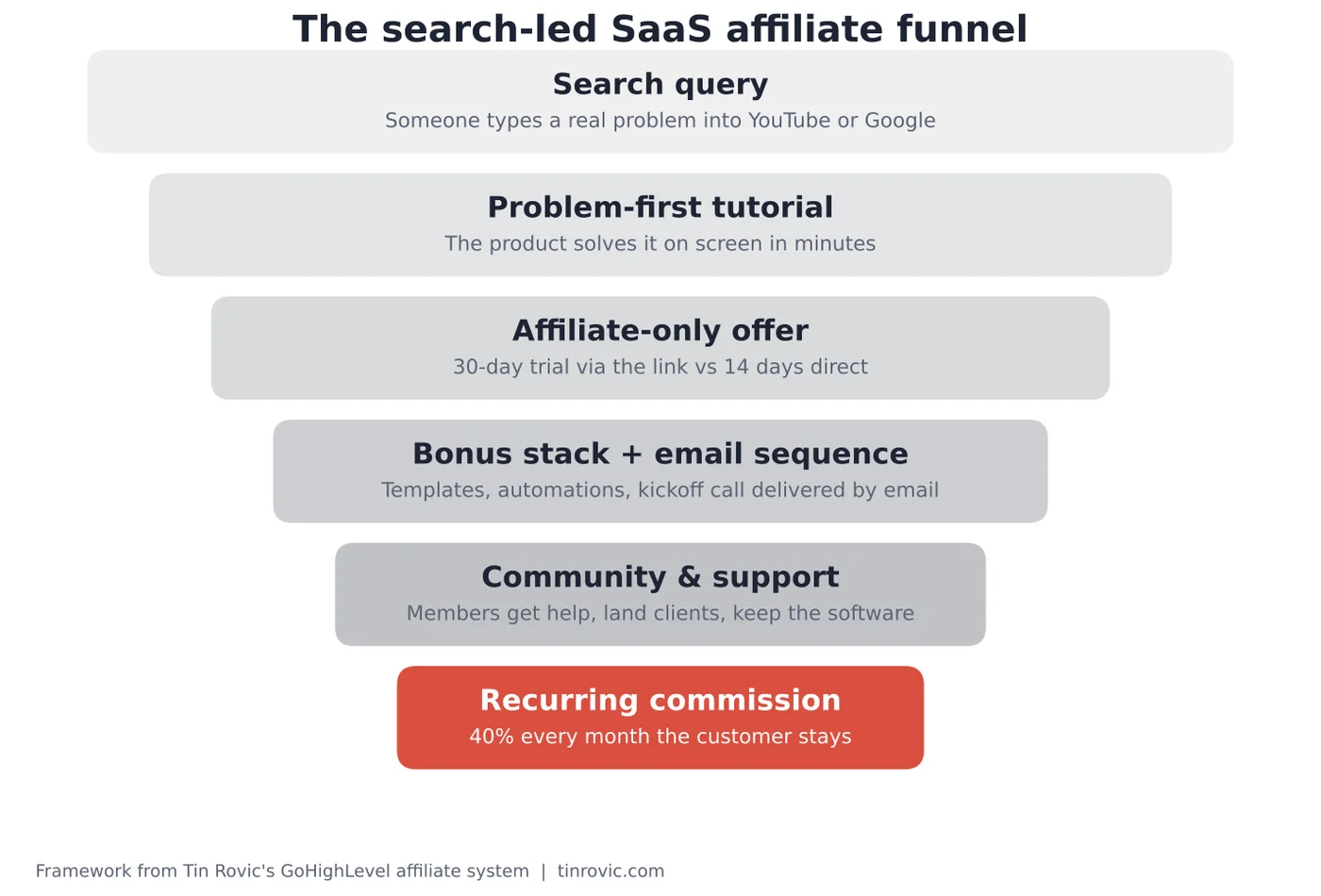
Stage 1: Start With the Search Query, Not the Product
The biggest mistake I see affiliates make is building content around the product name. “GoHighLevel review” gets searched, but it’s crowded, and the people searching it are already comparing tools.
I built content around problems my audience was already typing into YouTube: how to build an AI website for a local business, how to stop a plumber from missing calls after hours, how to set up an AI receptionist. The software shows up because it’s the tool that solves the problem, not because the video is about it.
Practitioner rule: if your video title would still make sense with a competitor’s product inside it, you’re targeting the problem. That’s the content that keeps getting found.
Stage 2: Make the Tutorial the Proof
A problem-first tutorial works because the viewer watches the outcome happen. In my videos I open the software, build something real in roughly 15 minutes, and show the result. No feature tour, no list of pros and cons.
This matters more than most people expect. Here’s one of those tutorials in YouTube Studio:
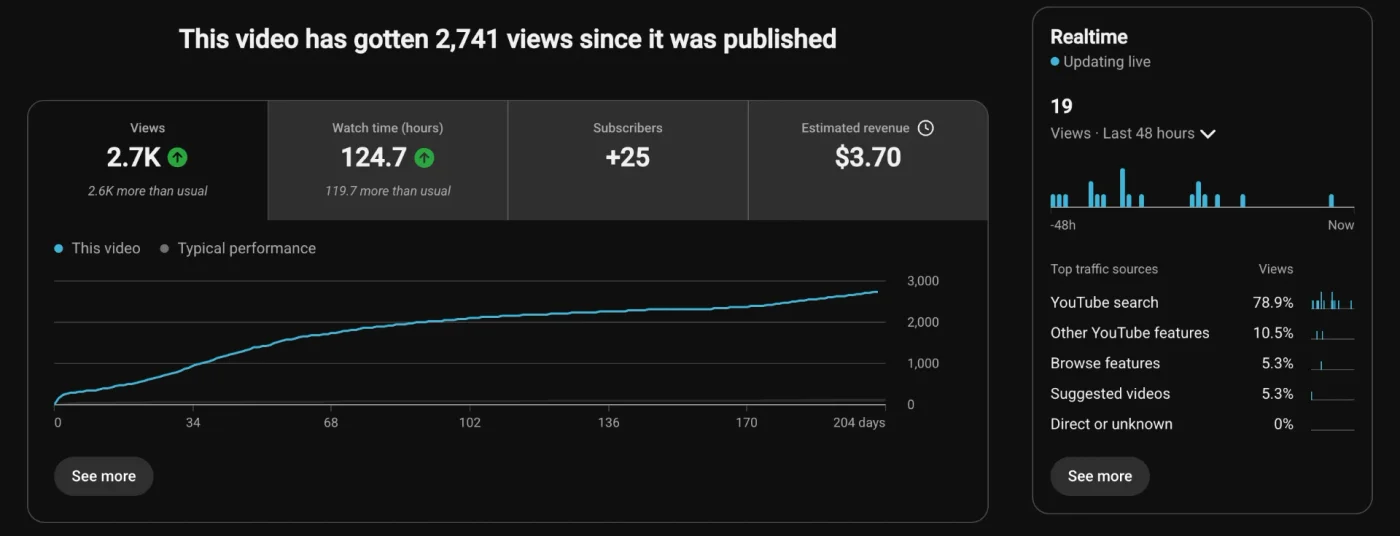
By creator standards, that video is small. It earned $3.70 from YouTube ads. But nearly 80% of its views came from people actively searching for the problem it solves, and those viewers are agency owners who need the exact software in the description. For affiliate marketing, a few thousand of the right views beat a hundred thousand of the wrong ones.
Stage 3: Give People a Reason to Use Your Link
This is where most affiliate funnels quietly break. A viewer likes your video, opens a new tab, types the product name and signs up directly. You get nothing.
GoHighLevel solved this for me with an affiliate-only offer: 30 days of free trial through a partner link instead of the standard 14. That one detail turned my call to action into simple math. You’re going to sign up anyway, so why not get double the trial for the same price?
If you run a SaaS program: an extended trial, a first-month discount or bonus credits that only exist on partner links is the cheapest conversion lever you have.
Stage 4: Stack Bonuses and Deliver Them by Email
Every GoHighLevel affiliate had the same 30-day trial and the same commission rate. My edge was the bonus stack I built on top: a private community, ready-to-sell templates (GoHighLevel calls them snapshots), outreach automations, courses and a free kickoff call.
The bonuses were delivered through a short email sequence. It handed over the bonuses, told my story and reminded people to actually start their trial. That last part is underrated. A signup that never logs in becomes a cancelled trial, and a cancelled trial pays nothing.
Stage 5: Turn Customers Into a Community
Recurring commissions are only as good as retention. My community was the retention engine: members asked questions, grabbed templates, watched podcast episodes with experienced users and used resources like a library of 55 prompts for GoHighLevel’s AI features.
When someone lands their first client using a piece of software, they don’t cancel it. Helping members get that first win was the most profitable work I did as an affiliate, even though none of it looks like “promotion.”
Stage 6: Let Recurring Commissions Compound
GoHighLevel pays 40% recurring. That changes how an affiliate behaves, because your income depends on customers staying, not just signing up.
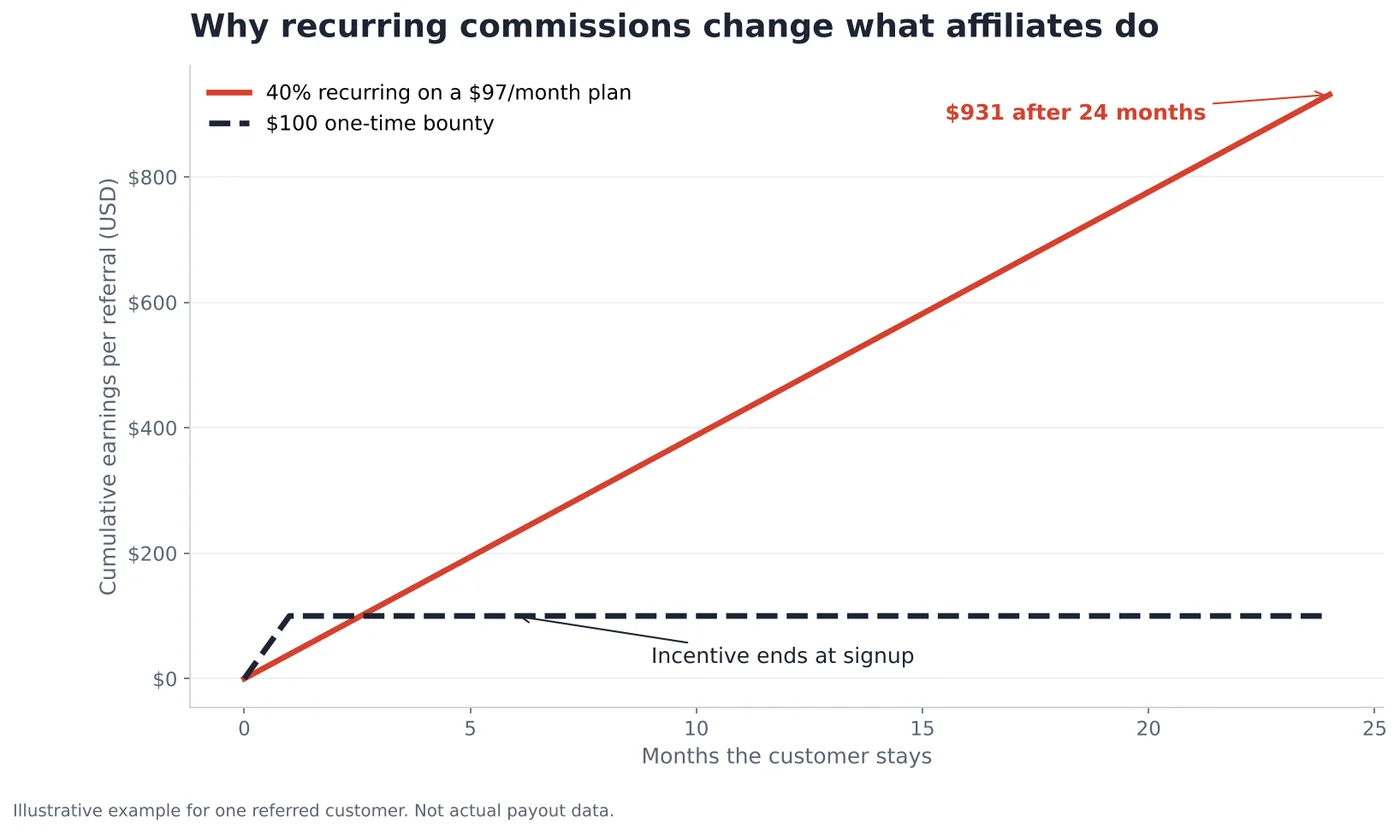
With a one-time bounty, my incentive ends the day someone signs up. With recurring commissions, I’m motivated to onboard, support and retain that customer for years. That alignment is the entire reason I invested in a community, templates and email follow-up. It’s also why the dashboard number kept growing long after the original videos were published.
Where SaaS Affiliate Funnels Usually Leak
After promoting dozens of SaaS products through sponsorships and affiliate links, the same leaks show up again and again:
- No affiliate-only offer. If the website and the partner link give the same deal, viewers skip the link.
- Product-name content only. Review videos compete with every other affiliate. Problem-first tutorials compete with almost no one.
- Hard-to-demo products. If a creator can’t show a real result in 15 minutes, they’ll pick a product that lets them.
- One-time bounties. They pay for signups, not customers, so affiliates stop caring after day one.
- No onboarding after signup. Trials that never start become churn before the first payout.
- Unclear tracking. Affiliates who can’t see which video converts will quietly stop making videos.
What SaaS Affiliate Managers Can Take From This
Almost every stage of my funnel was made easier or harder by decisions the SaaS company made. If you manage a program, these are the levers on your side:
- Publish a problem list. Give affiliates 20 to 30 problems your product solves, phrased the way customers search for them.
- Create an affiliate-only incentive and make sure it can’t be found anywhere else.
- Pay recurring commissions, even if it’s for 12 or 24 months rather than lifetime.
- Make setups shareable. Snapshot-style templates let affiliates build their own bonus stacks on top of your product.
- Recruit practitioners. Agencies, consultants and power users already have the use cases and the credibility.
- Show clean data. Clicks, trials, active customers and payouts, with links or UTMs that can be split by video.
The Practitioner Checklist
Use this before you publish your next affiliate video or launch your next partner campaign. If you can’t tick a box, that’s where your funnel is leaking.
For affiliates and creators
- The content targets a problem people search for, not just the product name.
- The video shows a real result built inside the product, ideally in under 15 minutes.
- The affiliate link is in the first lines of the description and mentioned out loud.
- There’s a clear reason to use your link: an extended trial, discount or exclusive bonus.
- Bonuses are delivered automatically by email, not manually.
- The email sequence pushes people to actually start and use the trial.
- There’s a place for customers to get help after signup: community, templates or support content.
- The program pays recurring commissions, so retention work pays off.
- You track performance per video or channel, not just in total.
For SaaS affiliate program owners
- Partners get an offer that’s better than what’s on your pricing page.
- You’ve shared a list of problem-based content ideas and keywords.
- A creator can demo meaningful value in one sitting, with a demo account or template.
- Templates, workflows or configurations can be shared through affiliate links.
- Commissions are recurring for at least 12 months.
- The dashboard shows clicks, trials, active customers and payouts, split by link.
- Payouts are on time, every time.
Final Thought
The $121K in my dashboard didn’t come from a big audience or a lucky video. It came from a funnel where every stage had one job: get found for a real problem, prove the product solves it, give people a reason to use the link, help them succeed and get paid for as long as they stay.
Fix the stage where your funnel leaks, and the numbers start compounding on their own.